
In the evolving landscape of private investments, financial advisors face a fundamental challenge: traditional performance metrics often fail to capture the true nature of returns in this asset class. As private markets continue to attract significant capital flows, the need for sophisticated analytical frameworks has never been more critical.
Beyond Simple Averages
The private investment sector, particularly in venture capital and growth equity, operates under fundamentally different dynamics than public markets. While arithmetic means provide convenient snapshots, they obscure the reality of highly skewed return distributions. Consider a typical venture portfolio where one investment delivers a 50x return, two achieve 3x, and seven result in total losses. The average might appear attractive, yet 70% of the portfolio failed completely. This disparity between headline numbers and actual outcomes underscores why advisors must adopt more comprehensive analytical approaches.
Understanding Distribution Dynamics
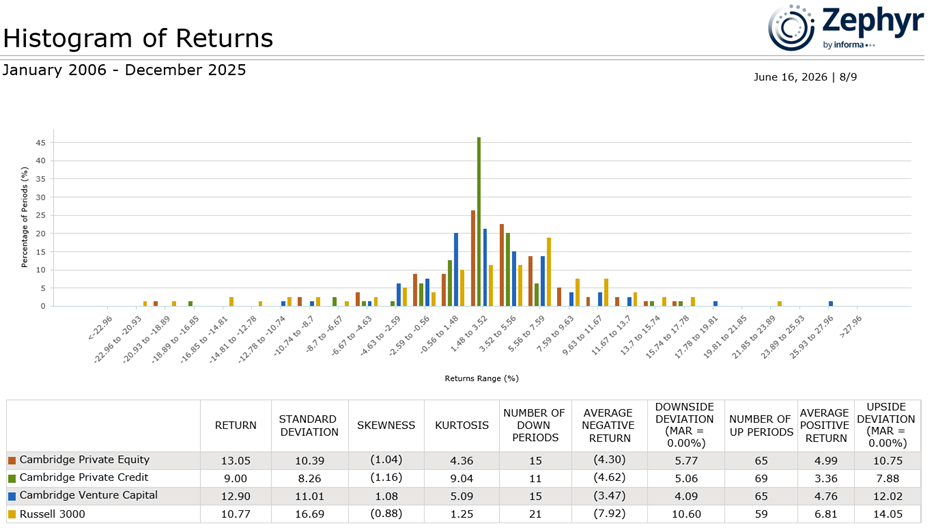
Private investments rarely exhibit normal distributions. Instead, they typically follow power law distributions, where a small number of exceptional performers generate the majority of returns. Research consistently shows that the top 10% of venture investments can produce 90% or more of total portfolio gains. This concentration has profound implications for portfolio construction and risk management.
The shape of return distributions reveals critical insights that averages cannot: the probability of loss, the number of successful investments needed to achieve target returns, and the degree of concentration risk. These factors directly impact asset allocation decisions and client outcome expectations.
Essential Analytical Framework
Financial advisors should employ a comprehensive statistical toolkit when evaluating private investments. Median returns provide more robust measures of typical outcomes than means, particularly for skewed distributions. Quartile analysis reveals performance across the entire spectrum, highlighting the substantial gap between top-tier and median managers, a dispersion that makes manager selection critically important.
Downside risk metrics, including the Zephyr pain index, maximum drawdown and Value at Risk, offer more relevant risk assessment than standard deviation for asymmetric return profiles. Meanwhile, skewness and kurtosis measurements provide deeper insights into distribution characteristics and the probability of extreme outcomes.
The Power Law Reality
Operating under power law dynamics requires a fundamentally different investment philosophy. Traditional risk management approaches focused on minimizing volatility may prove counterproductive, potentially screening out the high-risk, high-return opportunities that drive overall performance. Success demands larger portfolios to capture potential outliers, patience for companies to mature, and acceptance that many investments will underperform while a few generate exceptional returns.
Measuring What Matters
Both time-weighted and money-weighted returns serve distinct purposes in private investment analysis. Time-weighted returns isolate manager skill from capital flow timing, enabling fair comparisons. Money-weighted returns capture actual investor experiences, including deployment pace and distribution timing impacts. Advisors need both perspectives alongside return distributions to develop complete performance understanding.
The Path Forward
The substantial performance gap between top-quartile and median private investment managers makes analytical sophistication a competitive necessity rather than an academic exercise. By embracing comprehensive return distribution analysis and appropriate statistical measures, advisors gain crucial insights into risk, opportunity, and performance drivers.
This rigorous approach supports more realistic client expectations, improved manager selection, better portfolio construction, and ultimately stronger long-term outcomes. Financial advisors who master these tools position themselves and their clients for excellence in this increasingly important asset class.
 Adjusted for Risk
Leave a comment